Sunday, April 3, 2011

1950s SMALL TOWN LIFE/ NETTIE CALLS THE SHOTS

Honk, honk. Honk, honk, honk.  Hoooooonnnnnnnk!!!!

The first honks were like announcements of arrival.  The last one--insistent.  Just like my grandmother sometimes when she wanted us to do something.

"Nettie's outside!!" I yelled, looking out the picture window and seeing her big old lumbering 1953 black and white Buick.

"What does she want?" Susan called from her bedroom, where she was doing math homework.  I knew this because I had opened the door earlier and been told to get out because she was "doing math homework".  I knew she wouldn't leave her room anyway to go outside to see what Nettie wanted.  She never did. 

She was what I called  "an inside girl."  She had perfect, unmarred hands and fingernails.  She didn't like to get dirty or sweat.  And she would much rather read, or play Canasta or Scrabble than run down the sides of the creek or climb on the thick wooden rails of the corral.  I couldn't understand it.

On days when the entire family rose at 6 a.m. on a Saturday to work cattle,  Mother and Daddy usually  made a halfhearted effort to get her involved, then gave up, saying something like, "Well, you can set the table for lunch then."  Like that was a punishment!  They probably made a show mainly to keep Jan and I from whining about why she didn't have to help, and we did.

Nettie knew I'd always ride with her in her car,and sometimes Jan would,  riding through the dusty pasture roads, looking out at the Herefords grazing placidly on the thin grass, standing hip high in thistles and milkweed., stirring up the grasshoppers. I found their intermittent bawls oddly calming and pleasant.  Sometimes they jerked their heads up from eating, grass jutting from their white lips as they stared at us, unperturbed, chewing rhythmically on the green repast, saliva dripping from their mouths, watering the dry ground below.

She sometimes stopped the car suddenly, throwing up a small dust cloud behind us.  She opened the driver's side door, held onto the steering wheel and turned her ample body sideways.  Holding to the open door, she then stood up slowly, her arthritic knees creaking like two rusted  barn door hinges begging for oil.

"Hand me my cane," she'd say, "and my hat."  I stuck the wooden cane toward her from my place in the front seat while Jan grabbed the huge sombrero-like hat and set it on the driver's seat. Nettie  grasped the smooth wood in the curve of the cane handle, steadied herself, reached down for the hat, and after dwarfing her head with the monstrosity, started out toward the cows.  Prone to skin cancers, she wasn't taking any chances.  The hat and a long sleeved shirt were summer standards.

That was our cue  to get out of the car and scramble toward her.  She wasn't afraid of the cows and neither were we, but it was best to walk close to her so if she started a stampede, punching and yelling at them, that we weren't in their way.

"You old heifer, what are you looking at?" she'd ask, jabbing her stick toward a large red and white cow, with bags hanging almost to the ground.

"Why,  I'm looking at you," Jan would whisper, chuckling.  We stifled laughter.

"Where's your baby?" she said, louder, like the cow hadn't heard her the first time.  "Oh, I see him.  Right over there.  Now he's a pretty thang."  Now softer, like you'd exclaim over a mother's new baby, a REAL one, "He sure is.  Come here baby, come here."  The calf ran lickety split, kicking up his heels with abandon.  He was nowhere near Nettie  and not planning to come any closer by the way he was acting.

I shaded my eyes and squinted up at the blinding sun .  Jan kicked at a dried cow patty with the toe of her tennis shoe.  We weren't with Nettie  anymore.  It seemed to be just her and the cows.  I wondered if living alone as a widow so many years made her converse with things other than people.  She might talk to her furniture for all I knew. 

"Here bully, bully, bully," she teased.  "You old bull.  You think I'm afraid of you because of those big old horns.  I'm not afraid of you.  You made some pretty calves this year.  You sure did." 

She took a few steps forward, away from the car, and waded into the middle of the herd, about fifty cows.  Her felt Daniel Green houseshoes would be no match for this dust.  Her red and black plaid dress moved slightly in the hot breeze, and the back of the cotton longsleeved shirt she wore over it waved like a multicolor flowered flag.

 Most of the herd began  moving slowly away like bored guests at a dinner party moving away from a boorish speaker.  A few stood very still, looking at her, their slight defiance caving when she continued walking toward them, her cane stabbimg  into the ground, anchoring each step.  The bull was the last to cede his territory, but he, too, eventually moved out of her way, his 1200 pound body drifting slowly away like a large ship on calm water.   Hooves plodding, he gave a token shake of his long thick horns, their dirty ivory tips at least three feet wide.

We could never figure out why she did it.  The cows were having a perfectly lovely day, munching on grass and weeds in the pasture until she came and broke up their party.  There was no point.  Only to tell our dad, her son,  that she had "looked at the cows" and give her observations.  That was her contribution to the family business, I guessed.

She sure couldn't help us on Saturdays when we worked cows.  That was when the real work with the livestock took place.  Cows aren't very smart.  We'd often get behind them in the pasture and yell, walking them toward the corral.  Rarely, Daddy would saddle Sugar and try corraling them that way.  She was so lazy that she'd get tired and wouldn't run fast enough to herd them, instead trying to go to the horsebarn, a different place altogether.  If one of the methods didn't work, or too many decided to cut and run, we'd load a bale of hay in the back of the truck and they'd follow it like kids following an ice cream truck.They fell for the "food trick" almost every time, except in the spring when they had gorged on new grass.   


Once they were all inside the corral, we just shut the gate, and we had them.  Several of them would always run over and drink water out of the old porcelain bathtub that was their watering trough.  Then, it was a matter of culling a few at a time from the group, persuading them to go into the smaller pens and eventually running them into a corner where we could push a gate against their rear ends,  making their walking area smaller and smaller until they had to move forward in a line until each one individually reached the "squeeze chute."

That had to be manned by my dad or someone strong.  The cows were enticed in there because they could see an opening.  They occasionally had to be prodded with a hotshot, a metal stick with batteries that delivered an electric jolt.  In my father's defense, he didn't use it much or let others use it much.  Only with the most recalcitrant bovines.

My cousin Phil usually found time to chase Jan and I with it, threatening to shock us, and laughing happily at our screams.  He usually managed to herd us toward a cow paddy that we stepped in,  our feet  sliding wildly through the brownish green muck.  Simultaneously we shuddered,  shouted our disgust,  and ran for  rags to wipe off the slimy mess, all to the background peals of laughter of Phil and the rest of the "crew."

The "squeeze chute" was made so that the cow's  head could stick out through a gap in the bars, while  its body was squeezed tight.   But dumb as most of them were, they would imagine they could jump through the hole for their head and drag their whole body behind.  The chute was hinged on the sides, so my dad could "cinch" the metal bars tight enough to hold them still and then do the necessary work. 

It was hot, messy, nasty work, and the branding seemed downright cruel to me.  I could hardly bear to look.  A small fire was built and the branding irons placed there.  Once they were red hot, they were applied for a few seconds to the cow's hide.  The cows bawled-loud-but it only lasted a few seconds.  Then they had a new letter S on their right hip.

And they never seemed to hold it against my dad or even remember it after they escaped the corral.  The branding was always the last thing after tattoos were inked  into their ears with a tool that looked like it had a thousand sharp needles sticking out of it,  and shots were given for who knew what,  and they were doctored for anything else that was wrong with them. 

Some of them had pinkeye at times, and my dad squirted some type of drops in their eyes.  They also got sprayed with insecticide to kill the swarms of tiny flies and the thick, slimy white grubs that imbedded themselves under their tough hide. 

Sometimes one of the boys who might be helping work cows would mash hard on each side of a small opening on  the cow's hide and out popped a shiny worm, blasting up like a rocket, rising high above the cow's back, then descending like a failed flight, to the trampled dirt and manure inside the corral.

About 11:30 on cow working day, Mother headed for the house where she scrubbed her arms and hands, and prepared hotdogs, french fries, ice cold tea and usually a frozen dessert like lemon or chocolate cream pie.  When it was ready, she stepped outside holding a large cowbell in her hands, and shook it hard, till the sound was loud enough to reach us working at the corral. 

In a few minutes, the old turquoise truck pulled up to the garage and in tromped seven or eight sweaty and dusty  kids and adults.  Half headed to the two bathrooms while the others waited their turn for hand and arm washing at the sink. 

Conversations at the lunch table usually consisted of the morning's excitement, the wild cows, the bulls, the mad ones, the mean ones, the sick ones, the ones that tried to escape.   Everyone jockeyed for position to tell their story, waiting impatiently to tell their viewpoint of the activities.  Some times they got to, but more often my dad held center stage.  If he took a breath and someone talked really fast, they might get to tell something before he started in again. 

My cousin Phil was about 17 now, and he often came down and participated, though I couldn't understand why.

If I were an only child and lived in a nice, modern, and most of all "air conditioned" house, I doubted I'd ever come down to a hot place like this, that smelled  of manure and cow medicine and sizzling cowhides.

"Hey, where were you this morning, Snow White?" he teased Susan.  She ignored him, but you could tell she, like the rest of us, never got mad at him.  He was totally good natured about everything he said and did.  He was like the seventh kid in the family when he was there, but better natured.

"I set the table," she finally said, like it was justification for something.

He could always get away with saying things to my dad we would never say.  He made fun of him for getting so worked up and yelling and cussing the cows which was as much a part of cow working days as sweating.

"Hey," he called across the timbers of the chute one day, his arms hanging across the third rail, feet planted on the first, "you'd bawl too if someone stuck a hot iron to your butt."

We all watched to see my dad's reaction.  His face was already red and flushed from the heat, the effort, and the frustration with the cows, who never seemed to understand what was expected of them.  I watched as his face appeared to turn from red to fuchsia. 

Then he was done branding the cow, and his shoulders relaxed.  He released the bar that held the cow's head in place, and she backed up fast, her rear end slamming against the metal gate behind her, hooves scrabbling on the dirt of the chute.  My older brother Elton Jr. was at her head and released the pin on the small gate that had held her and swung it back, running backward quickly, not because he was scared of her, but to encourage her to run forward.

Once she saw the opening created when Jan or I slid the corral gate open at the end of the chute, she took off for the opening, kicking her heels wildly as she exited to open pasture.  By that time, we had jumped on the corral fence to make sure we didn't get her happy back feet in our faces.  We were always amazed that these lumbering beasts could move with such agility as they ran, their back feet leading, twisting their bodies up and around like an invisible hand was wringing them out like a dishrag.

Daddy watched her go, laughing at her antics when she got outside the corral.  Then he picked up the branding iron and held it toward Phil, who was safely across the chute.  "Boy," he said, "you keep on and we may have to use this on you."

We all laughed, then looked toward Phil, whom we knew would have a retort. 

"Yeah, well, you'd have to catch me first, short man," Phil said to peals of laughter.

My dad didn't say anything, but I could see him smiling as he pitched the branding iron back on the fire. 

'Well, I believe we're about through for today, boys and girls," my dad announced,  at the same time that we noticed a black and white buick moving toward us like a mirage, the sun reflecting off the shiny metal bouncing up and down in the middle of a thick cloud of brown dust.  We could barely see Nettie's head over the steering wheel, but we could see the huge sombrero-like hat, sticking out on each side.

Honk, honk, hoooooooonnnnnnnnnnk!

"Yes your majesty?" Phil cracked, sweeping his hand across his body and bowing at the waist.

"Let's go, everybody!" Daddy said, moving toward his mother's car.  "Nettie's here for the day's report!" he laughed goodnaturedly.

Sunday, March 20, 2011

1950s SMALL TOWN LIFE/PUPPIES BY THE DOZEN

Jan and I developed a strategy to deal with the wild, scratching puppies.  We walked simultaneously to the pen, watching them rolling, jumping on one another's back with their paws, nipping each other goodnaturedly, swinging their heads like swords to aggravate one another., all the while yipping in their high, squealy voices.  One of us would walk toward the back of the pen, outside the fence, while the other slipped toward the large heavy gate that opened from the front into their play area.  The "distractor" would squat down, stick her fingers through the tiny mesh squares, and call kindly to them. 

"Puppy, puppy, come here," she called.

They fell for it day after day.  They stopped mid jump, mid yelp, mid roll, mid head swing--looked around for a second to see where the sound came from, then like hound puppies always reacted, bounded all together and all at once toward her like she was their long lost best friend.  They would entertain themselves trying to lick, nip, rub, or touch that one finger, or if she could manage, a few fingers.  A few jumped on the fence with both paws, trying to get closer to her, barking, seemingly trying to talk to her, get her attention, share their heartfelt love.

All the while, I was easing through the big gate, hoping its hinges didn't squeak too loudly, calling them back.  I balanced  the large metal pan of dogfood mixed with warm water.  As soon as the pan cleared the gate, I put it down quickly on the hard packed dirt and bolted back through the opening before the gate shut behind me.  If I was lucky, I got out without hanging a piece of clothing on the sharp metal fencing or nicking a leg or arm on a wire sticking out, escaping  milliseconds before the whole herd of puppies saw me and bounded for the food pan, leaving Jan standing alone like a wallflower abandoned at a school dance.

We'd saved their lives in a way.  Not once, but twice.  Their neurotic mother had them under our long house.  Naturallly, she gave birth under the living room when the closest entrance to the crawlspace was under our bedroom window, ten yards away.  Daddy was short and rotund, active, but not able to squeeze into tight places.  He was also claustrophobic. Thus, he drafted us.  We reneged, refused, retreated.  He begged, beseeched, and finally bribed.

We could hear the little squeals, high pitched and frantic.

"All right, girls," he said, a slight smile forming on his full face.  "I'll give you fifty cents for every puppy you bring out."

Jan and I looked at each other and rolled our eyes.  Risking snakes, skunks, worms, moist dirt that smelled like musty clothes, and the occasional wasp seemed like it was worth more than the three dollars apiece  those puppies might generate.  Daddy was guessing by the noise under there that there might be about twelve of them.

We knew we had to get them out though.  Jik was a bad mother.  Twice previously, she had litters, then they mysteriously disappeared.  Daddy said she killed them though her mild manner made us doubt him.  He knew animals though.  And we believed him, though we didn't want to think about it or hold a grudge against Jik.

"Okay, I need somebody to crawl under there," he said, his face getting a little red, his voice more insistent.

"Let's both go," Jan suggested.  It wouldn't be quite as creepy if someone else was experiencing the terror simultaneously.  "A dollar a puppy," she said, acting like a businesswoman in important negotiations.

"Dollar per puppy," Daddy said.

"Okay," I said suddenly, like I'd been stuck with a cattle prod, (we called them hotshots).  "Let's go."

And with that, we both lay down flat on the green bermuda grass, her first, me second and shimmied through the dark opening.  The dirt smelled like it'd been there since time began and made me gag a little.  My eyes strained to adjust to the dark space.

"What was that?" Jan asked in a startled voice.

"Nothing.  Just me gagging at the smell."

"Oh...it's hard crawling under these pipes," she said, grunting as she pulled herself along, leaving an indention in the dark sandy soil like a huge snail. 

"How far do you think we have to go?" I asked her, aiming the flashlight Daddy had rolled under the house to us.

"Hey, shine that a little higher so I can see," she said, glancing back at me.  A little dirt clump clung to her blonde pony tail.  I wanted to make a joke about it being a rat pill, but I was petrified of rats so even thinking  it made me shudder.

"I see 'em now," she said.  "Oh man, there are a lot of them.  They look like a big, writhing, black and white snake."

"Don't talk about snakes," I scolded her.  "It makes me want to get out of here fast!  I hate this!"

She strained forward, me crawling behind her, my nose almost touching the soles of her tennis shoes.

"Awww, here little fella," she said, a soft tone entering her voice now.  "Come 'ere.  Let me have your brother too."

She handed something warm and furry to me.  It squeaked, its eyes tightly closed.  I didn't want to be under here, but I felt compassion for the little thing.  It couldn't help it that it had  pscyho dog for a mother. 
I tucked it in the crook of my right elbow and started dragging myself forward with my left arm, pushing with the tips of my toes for added momentum.  It seemed to take forever, but then I saw the light of the outside opening.

"Here," I said, holding the tiny puppy out into the light.  Hands reached down to take them.  Someone had arrived to help my dad.  Probably Mother.  I thought I saw my cousin Phil, too. With that, I moved my body in a circle, my toes slowly making an arc like the metal compasses we used at school, and started back for another puppy.  Jan was right behind me.  We repeated this process six times.  On the last trip, we emerged to the bright sunlight, squinting and covering our eyes with filthy hands.  Our clothes looked like those in the pictures of the poor white kids in the Dust Bowl, filthy and board straight. 

"Twelve dollars, please," Jan said, holding out her hand to Daddy.

He thought a minute.  "Ok," he said, "I'm going to knock these puppies in the head.  I'll sell 'em back for a dollar apiece."  He looked toward Phil and grinned.

That ruse only lasted a minute before my mother gave him a stern look.  We had already started hopping up and down, begging for their lives. This was, to my mind, the second time we saved them.

My dad was grinning as he got out his wallet and paid each of us $6.  Mother was heading for the kitchen to fix supper, and she didn't seem to see the humor in it at all.  I guessed that tonight he wouldn't repeat that little joke--not in her hearing anyway. 

Thursday, March 10, 2011

1950s SMALL TOWN LIFE/CANDYSTRIPING


Long on compassion and short on common sense, I figured I'd be the most dedicated Candystriper to ever push her way through the heavy glass doors at Navarro Memorial Hospital .  Several of my friends and I decided to volunteer there  the summer we turned 15, in 1965.  Unbelievably we had our drivers' licenses and could now drive ourselves directly to the hospital parking lot, hop out, and hurry inside to assist the masses of sick patients we imagined were waiting anxiously for us behind closed, fireproof doors.

A half day orientation, provided by various members of the hospital staff and coordinated by our own aging beauty queen,  Elaine Mayfield, the "volunteer on a pedestal,"  taught us most of the very basic hospital rules we were to observe as Candystripers, and which, after lunch, we promptly forgot.   We adored Elaine , her kindness surpassed only by her beauty and self assurance. Wrapped in her layered silk designer clothes of multicolored fabric, fluttering her extra long eyelashes, swooping her diamond laden hands about for emphasis, and speaking in her perky, but sexy, gravelly voice, she walked through the darkish green corridors of the hospital--a swan, with a gaggle of awkward geese trailing her. 

"Now girls," she said, making a large sweeping motion with her hand, "here is the nurse's station.  You are not to go back there.  All those records are confidential, and that is offlimits to Candystripers, though we know that all of you are very trustworthy and would never violate confidentiality.  Down here is the breakroom.  If you want to eat something, you must come in here.  And all along this hall," she said touching her long, perfectly manicured red index finger nail to her perfectly lipsticked red lips, indicating 'shhhh', "are the patients' rooms.  And we must be very quiet in the hall because everyone here is sick, and they don't need noise--they need silence," she whispered.

I felt my heart rate quicken.  Who was behind those doors, and what could we do to help them?  I almost ached to open a door, introduce myself, and "fix" something for someone. 

Elaine smiled at us benignly.  She let us call her Elaine, which made us feel very grownup and cool.  After all, she was married to a doctor, and she used to live in Dallas where her father was a famous pastor, and she a beauty queen, sweetness and kindness amplifying her enviable persona, an unattainable standard by our estimation. 

"Now girls, just remember.  You are representing me.  I coordinate the Candystripers, so mind your manners.  And do whatever the nurses tell you.  They are the bosses while you are here.  Thank you for volunteering, and I hope you have a wonderful time doing this.  You will be helping others."

With that, she waved a tiny goodbye, smiling broadly, the red nails of her right hand moving like tiny red hinges, up and down, rhythmically,  beside her Geisha girl face, powdered to perfection and boasting large eyes that slanted up just the right amount at the corners.  The five of us stood silently, barely moving,  after she turned away, watching her click down the hall in her gray stiletto heels, her beautiful frosted hair, swept up in a sophisticated twist in back.

Nurse Ruby appeared at that minute out of one of the patient rooms, her starched white uniform and crisp hat telling us she was an RN.  All the nurses wore hats, but the LPN hat was different, so you could tell which people had a year of training and which had two.  The RNs were always in charge. 

"Could two of you girls come here?" she asked.  Nilene and I quickly stepped forward.  "Come in here," she ordered, but nicely.  She turned and sent the other girls to the waiting room and asked that they straighten it up a bit and said she'd be right with them. 

"I have the patient, Mrs. Saunders, in a chair.  She needs her linens changed.  Can you girls handle that?"

Nilene and I exchanged nervous glances.  Well, I made my bed at home and she did too.  Why not?

"Sure," we said, looking toward Mrs. Saunders, who appeared to be in pain and obviously needing to get back in her bed as soon as possible. 

Pointing to a stack of fresh linens on the chair next to Mrs. Saunders, Nurse Ruby turned on her heel and left, easily pulling open the heavy wooden door with its silver handle, ostensibly leaving to deal with the other three Candystripers.

Mrs. Saunders gave us a weak smile.  "I've just had surgery," she said almost apologetically.

We each got on one side of the hospital bed and started pulling the sheets off and then the pillowcases.  I couldn't look at Nilene or I would laugh, so I didn't-look at her or laugh.  We looked around for somewhere to put the dirty linens, but seeing nowhere to put them, we stuffed all of them in a pillowcase and put the whole lot out in the hall, neatly, right beside the door.

I knew we needed to put the head of the bed down as it was tilted at a 45 degree angle, but I'm no good with anything mechanical.  My dad used to quote a comic he liked, saying, "Leroy, get away from that wheelbarrow.  You know you don't know nothing about machinery."  I can't say I thought the joke was too funny since I often had trouble managing even the simplest mechanical tasks. 

I motioned to Nilene to go to the foot of the bed.  After raising the end of the bed slightly, then using a different crank and raising the head of the bed more, she finally figured out which crank to turn and in which direction.  The bed lay before us, pristine and flat. 

We took a thick, clean white sheet and raised it between us letting it fall gently to the bed.  Then we tucked in all the corners.  I'd even been shown by my Aunt JoAnn, who had nurse's training and wanted me to become a nurse, how to fix the corners so they fit tight.  Nilene let me do all four corners while she retrieved the second sheet. 

Mrs. Saunders was groaning a little, leaning forward just a bit in the chair and holding her stomach, and it was making both of us nervous.  I could tell, because Nilene was not smiling at all and she kept glancing at Mrs. Saunders and furrowing her brow each time she did.  I just wouldn't make eye contact with either of them.  I kept saying I was sorry it was taking so long, but Mrs. Saunders didn't respond.  I hoped she wasn't getting mad at us.  The air conditioner unit under the large window droned on like it had become bored and disinterested.

Finally, we had both sheets on and needed only to stuff the pillows in the cases.  There were two, one for each of us.  We had been told not to put them under our chins because of germs transferred from us to the cases, but of course in our haste and nervousness we forgot. 

We heard Nurse Ruby before we saw her.  "What is this, what is this?  Out here in the hall?  So much for universal precautions.  No, no, that will never do."

She practically roared into the room, dirty laundry pillowcase in hand, and caught both of us with pillowcases firmly tucked beneath our chins, trying to stuff the pillows in.  She grabbed both, placed them unceremoniously in the dirty linen case and told us to take it to the laundry chute while she got Mrs. Saunders, who was now bent completely in half, moaning loudly, in bed.  "Then bring me two new pillowcases and I will  show you how to do it properly," she huffed.

I knew it would make a bad day worse, but I just couldn't stop myself.  Sometimes I was like that.  Curious.  Also, entertaining friends sometimes got the better of my usual solid judgment.  I just wanted to look down that laundry chute, and up it too.  It would make Nilene laugh.

We were on the second floor, the surgery floor, and Nilene opened the silver door to the chute and dumped our linens in.  We heard a tiny sound, barely audible, as the bundle landed in the hospital's distant catacombs.  I wanted to go see where it landed, but that would wait for later.

Right now, I just wanted to look up and down the chute, see if I could see anything.  Nilene urged me to do it.  I moved beside the chute, and bent at the waist at a 90 degree angle to the opening.  Nilene was posted by the door watching for any nurse, but most of all Nurse Ruby.  Just as I prepared to stick my head in the chute,  looking toward 3rd floor where they delivered babies, a large load of dirty linens flew by on its way down.  As I jerked my head out of the silver metal chute, I heard the laundry land with a "whumpf", a much louder and more distinct sound than had been made by our paltry bundle of sheets.

I turned to Nilene, my eyes huge.  "I never thought about how often it's used or how big the loads are, did you? 

I could tell by the stunned look on her face she hadn't.  She nodded mutely.

"That could've broken my neck!" I exclaimed.

Quietly closing the door until the handle clicked, I started looking around for the clean pillowcases we needed to deliver.  Just then, Nurse Ruby appeared at the door.  "Why haven't you girls brought the cases?" she asked. 

"We can't find any," Nilene said.  I was still looking because I didn't want her to be any madder at us.

"Oh, well, it looks like there aren't any.  Okay.  I need you girls to go down to the laundry in the basement of the hospital and ask for some.  Do you know where it is?"  We shook our heads.  We didn't.  She told us how to get there.

"And on your way, return this proctoscope to the medical supply office."

I took the approximately one foot square cellophane sealed package in my hand.  Inside was something that looked like a small garden hose with a pointed end.  "What is this anyway," I asked. 

She grinned.  "Something they use to look for problems in the intestines," she said.  "You probably don't want to know any more than that."

I didn't.  And Nilene was strangely quiet.  She usually jabbered nonstop, making jokes and causing me to laugh at inappropriate times.  Just now, she stood silent as a guard at Buckingham Palace.
We took the elevator down, and when the door to the basement opened, it was like another world.  Quiet, a little dark, the air seemed heavy and there was an odor, like in Mr. Bittner's storm cellar in Purdon when it had been closed up all winter. 

About ten yards from the elevator, Nilene jerked her thumb toward a sign on the door.  "Morgue," I read aloud even though Nilene was immediately shushing me like I shouldn't say it.  "What?  You think someone is going to hear us?" I asked. 

We walked a little further, our steps becoming more tentative. There was the big brown industrial size door with the words Medical Supply on it.  We knocked softly, and a man in his forties opened the door.  "Hey, good to see you," he said like he knew us.  "Whatcha got for me?  Nurse Ruby said you girls were bringin' me somethin'."  I held the package out toward him, straight in front of me.  "Oh," he said, inspecting it.  "A proctoscope.  Wonder why they didn't use it?  Someone's lucky day!"  And he laughed a big, hearty, laugh eyeing us the whole time like he was expecting us to join in.  We didn't.  We stood rigidly, each of twisting the toe of one tennis shoe like a hand drill boring into the tile floor, waiting for him to finish.

"A proctoscope." he said one more time.  "Well thanks girls.  Have a good day today.  And come see me again."

"Okay," we said, not meaning it, and ducking out sheepishly.

We still hadn't seen the laundry after we re-entered the corridor.
Finally, we turned a corner and we could see the laundry through glass paneled doors.  Workers stood in what looked like an underground cavern before enormous black carts filled with white sheets, towels, pillowcases, and blankets, and patterned hospital gowns with Navarro Memorial Hospital stamped on every item.  Two fullsome ladies with skin like brown velvet held a sheet between them, then walked toward one another, folding it as they moved.  Another lady sat at a small sewing machine over in a corner repairing items, we surmised.  As we approached the doors, the two "folding ladies" smiled broadly and motioned for us to come in .  The thick steamy air hit us as soon as the door cracked a little, like all the air was trying to get out of there and go someplace cooler.  My hair felt damp, and I could feel my arms getting moist.  Nilene's curly hair had already started to form little blonde ringlets around her forehead.

"Can we help you girls?" one of the ladies asked.

"We're looking to buy some pillowcases," Nilene said, making a joke. 

"Well, how much do you want to pay?" they laughed good humoredly.  Finally, someone who knew how to joke with us.

"We might just trade out some work down here for them," Nilene went on.  I had the sick feeling they might take us up on the offer, so I kicked her ankle slightly with my foot, but not where the ladies could see.

"I think we have some free ones," V. Smith said.  I noted her name tag.  "How many do you need?"

"Two, I think," I said.

"Two?  That isn't enough to even get started."  And she laughed a big deep laugh from somewhere in her good heart.  And the other six workers started laughing too, but in a nice way.  "Here's eight. And if you need any more, come on back down here.  We'll still be here."  The others all smiled and nodded at her as though she spoke for all of them.

'I sure hope getting this many pillowcases redeems us with Nurse Ruby," I said.  "I wonder if there are some different jobs for Candystripers that we'd be better at than bedmaking?"

There were, and once I discovered the Goody Cart, that became my regular  job.  On Saturdays, one or two of us would take the Goody Cart to each room, except those posted "Keep Out."  The cart had magazines, candy, drinks and gum.  Lots of the patients bought magazines and other snacks.  I could make change, and I was exceptionally honest, so there was never any enticement to keep a quarter or eat candy I didn't pay for. 

My only problem was that I had a sweet tooth, and we were not allowed to eat while doing our jobs, so the whole two hours or so that we were delivering, I was salivating and thinking about what candy I wanted and how good it would taste.  The best were the chewy pralines.  You couldn't really find them to buy anywhere else, so I looked forward to Saturday, usually rewarding myself at the end of the shift with a praline, or two.

We were allowed to get ice from the machine in the kitchen for the patients' drinks, so one of us often ran back and forth getting ice while the other sold our wares.

I was still entertaining the notion of becoming a nurse, figuring they'd correct my poor bedmaking skills, but on a particular day I saw Nurse Ruby, who was in charge of the whole floor which might as well have been the world,  exiting a room with an emesis basin, which we laughingly called the earp bowl. 

I figured if I became a nurse, I'd try to be in charge, and then I wouldn't have to do some of the nastier chores that made me gag and cough.  However, on this day I saw her carrying the emesis basin, and it was full of a vile brown liquid.

"What was that?" I asked later, almost coughing in front of her, thinking of it.

"Tobacco juice", she said, a euphemism for a sickening slimy tobacco and spit combination.  "Just part of the job," she said cheerfully.

 But I never asked her another question about being a nurse, because I made up my mind if someone as competent as she had to do such disgusting chores, I didn't think I'd last in that field. 

School started in the fall, and we soon forgot our red and white striped pinafores, white starched shirts, and fake white nurses' hats.  We hadn't really quite  measured up to Florence Nightingale's standards, but we had fed people's need for candy and information through the summer, and as teenagers we could have done a lot worse with our time.  And at summer's end, Elaine invited us to her elegant apartment for lunch to celebrate what we'd done.  Everything we did with her seemed special and unforgettable.

"Gonna volunteer next summer?" Nilene asked me as we climbed the stairs to Elaine's apartment.

"I'm not sure.  You?" I asked her.

"Nah.  I think I helped enough people this summer," she said, laughing.  "I think we've helped enough sick people for one summer."


Sunday, February 20, 2011

1950s SMALL TOWN LIFE/POOR PITIFUL PEARL

I had my favorites with my toys.

Monkey cost $5, and I bought him at F.W. Woolworth in Corsicana with some money I got for my fifth birthday.  I slept with him and drug him around with me until the inside stuffing on his arms let go at the armpits giving him a decidedly limp look.  He had black arms and legs,  a yellow torso, rubber human-looking hands with knuckles and fingernails, and cute white rubber baby shoes, made right onto his legs so they didn't get lost. 

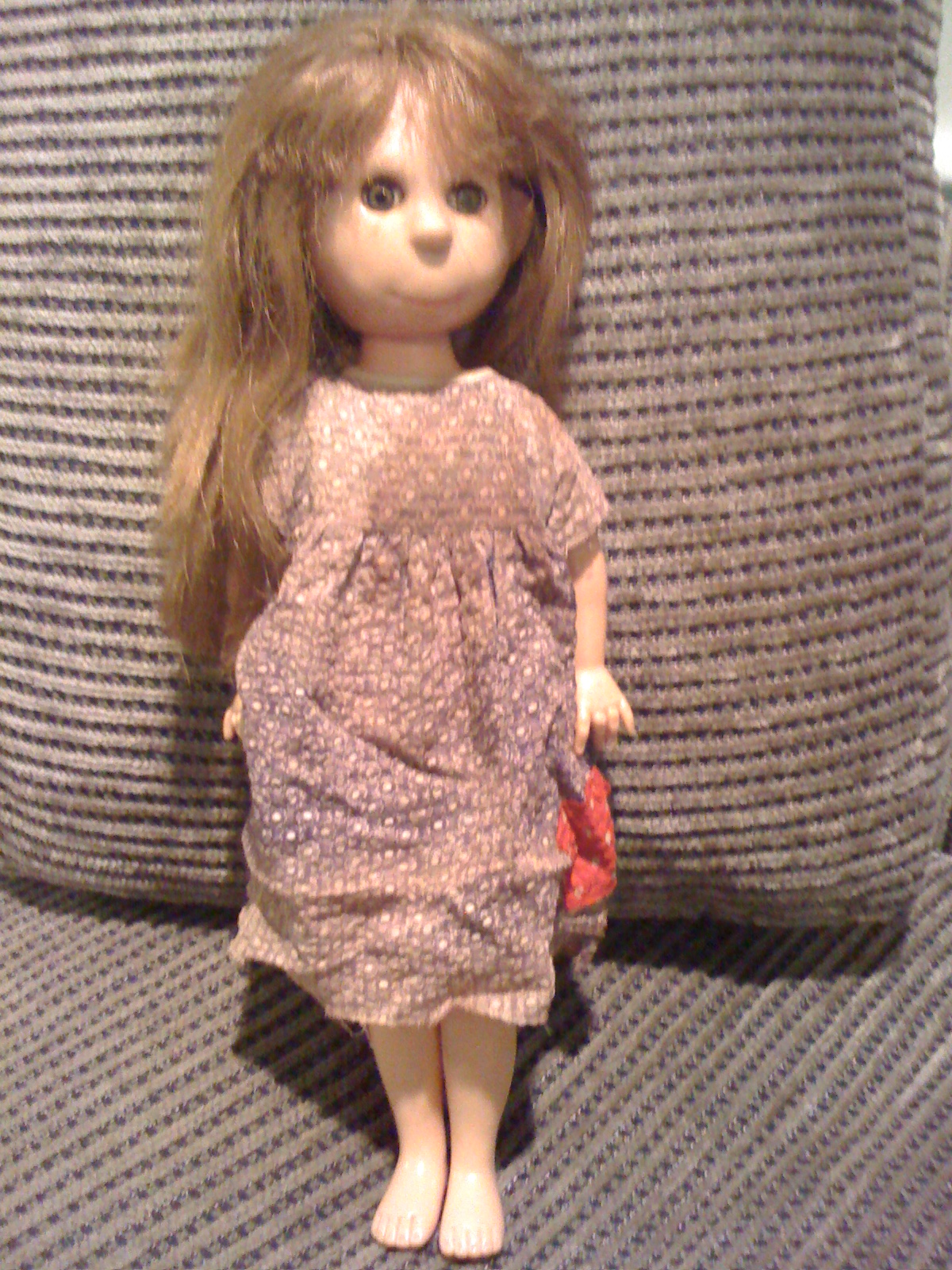
The year I was 9 and ordered Poor Pitiful Pearl as my Christmas gift probably marked the setting of some inner orientation.  She wasn't pretty like some of the other dolls we'd received in Christmases past.  She had dishwater blonde hair, a color  my brothers made sure I knew matched my own.

Her hair was coarse and stringy.  Mine wasn't like that, thankfully.  She had a kind face, not haughty like the 14, now 13,  joint ballerina Jan got the year before.  She wasn't what you'd call cuddly like the soft baby dolls in their little white organza gowns either.  But something about her made you want to hold her close and tight, protect her. 

She came with two sets of clothes, a blue shift with a red rag to go on her hair, one that looked like it would be worn by a little girl who would sell matches on a  streetcorner.  The other was a fancy Sunday dress made of thin blue organza material with a nice black velveteen ribbon to tie her hair up in a ponytail.  For her everyday outfit, there were soft black boots; the fancy outfit had white Mary Jane shoes to go with it. 

During those years, I loved, in this order:  Julie, my dog;  Monkey, my stuffed animal; and Poor Pitiful Pearl, my doll.  Well, my parents and sisters and maybe even my brothers were in there somewhere, but I was very attached to my strange little group of four-legged and inanimate friends.

Neila never expressed an opinion about my doll.  She would look at me brushing her hair, get a quizzical look, then laugh, followed by "Poor Pitiful Pearl", said with real pity, almost like a question.   

Mother always simply got us what we requested as gifts, within reason, no questions asked.  She never seemed to reflect upon the whys or the what fors.  I'm sure she was much too busy.

Neila, on the other hand, seemed to find my selection of the doll amusing for reasons I couldn't fathom.

The boys had gotten a chemistry set a few Christmases before and nearly ruined the desk in their room, letting things burn and sizzle till the varnish melted off in places; other parts of the desk had red, blue, or green globs of who- knew-what all over it.  Mother didn't think about the disasters they could create, the other people who might get hurt, or what it would do to her furniture.  Hadn't she already told another girl who asked, that she'd just get new furniture when all the kids grew up?

The dolls, by contrast, were totally calming.  I continued to brush her hair with the little plastic brush that came with her and then showed her what she looked like in the tiny plastic mirror.  Her facial expression never changed from the pleasant near-smile, but I felt sure she was pleased. 

"There, there, now.  You can go to Sunday School in your pretty dress.  Would you like that?" I asked the kind but homely face.  "Do you like your new clothes?"

Neila observed from the kitchen doorway, watching me intently. 

"Isn't she pretty now?" I asked.  "Look how pretty her hair is in a ponytail.  Do you like it?"

Neila seemed perplexed.  She didn't answer quickly like she usually did.  She continued to watch me turn the doll this way and that, smoothing her dress, adjusting her socks, pushing her shoes on firmly. 
Finally, she just said "Poor Pitiful Pearl", smiled, and turned away to get something out of the refrigerator. 

"I don't really want you selling matches anymore," I told her.  "Maybe now that you live with us, you can have a normal life.  I'll have to get you some more clothes.  You don't really have to wear the rag dress anymore if you don't like it."     ------------  "Do you like it?  You don't, do you?"

I patted her arm tenderly.  She wasn't a baby doll, not one you'd turn sideways and cradle, but still I wanted to reassure her, rescue her from her sorry past, and remind her endlessly of how much she was loved now.  She responded with her unfailingly kind smile, its sad origins tugging at the corners of her mouth, trying hard to turn them downward.

She seemed to like Monkey okay, so when I had to leave her, I often left her sitting between Monkey's fat legs, encircled by his protective furry arms.  "There," I'd tell her softly.  "Monkey will keep you safe until I get back.  He's not scary.  He's nice.  He's been with me since I was five.  He'll be a good friend."

 Jan had a lot of dolls.  I guess we held most of them in common, but I didn't play with them much.  However,  when it was cold, I felt compelled to cover all of them with scarves, bandannas, tiny quilts and blankets made just for dolls, and by the time we finished (I always begged Jan to help me, and even though she thought it was silly, she did), the stacked brick and white plank shelves on one side of our room were bedecked with red, white, royal blue, ivory, pink, and deep emerald green cloth of every type of material from chenille to satin.  A few tiny dollheads peeked out from under the covers, but we didn't allow any arms or legs above the covers in order to protect them from frostbite.  It got really cold in the house at night.  We had space heaters in the early days of living there before my uncle Bo and Aunt JoAnn practically donated and installed a real central system in the house. 

Mother would light the heaters in the morning before we got up, and we usually ran to the den, which was warmer, carrying our clothes with us, dressing there quickly.  We appreciated Mother lighting the heaters, which we weren't allowed to light anyway until we were older.  I figured the dolls appreciated our putting the covers on them even if they couldn't tell us.  Once it warmed up, we took the covers off in the afternoon when we got home after the 45 minute bus ride from school.

Poor Pitiful Pearl became the rather unlikely queen of the dolls.  I played with her, changed her clothes, talked to her, and made her the star of our doll plays.  Only a few dolls were taller, one being the giant "Bride Doll", but she was somewhat dull in my estimation. Not much personality. And the only thing she had to wear was a white bridal gown, which was becoming smudged and unsightly.  We'd long since lost the veil. 

I knew the other dolls would eventually be given to nieces or the Salvation Army, but I wouldn't part with Pearl.  She was placed lovingly on a shelf open to view in the bedroom and would sit there patiently, even through my high school and college years,  her enigmatic smile reminding me of a picture of the Mona Lisa that I had seen in Life magazine.  She didn't seem to mind being there, whether we played with her or not, or whether anyone even dusted her off .  She was safe in this house with a loud but loving family, and that seemed to satisfy her.  Her face now seemed to reflect a secret knowledge and contentment.

I didn't remove her from the shelf when I left home, but years later, I would retrieve her and give her a place of honor on a new bookshelf to the chagrin of my teenage daughters.

 "Poor Pitiful Pearl," I could almost hear Neila croon, followed by a little laugh.


Sunday, January 30, 2011

1950s SMALL TOWN LIFE/BRUNETTE AND BLONDE NIGHTMARE

I sit straight up in bed, my heart  pounding, and panic makes me unable to think  clearly.  I twist like a corkscrew and see by the faint light entering the windows that both Susan and Jan are asleep in their beds.  My heart slows a little, and my thoughts settle slowly like feathers drifting to earth. 

Now I remember what woke me.  THE DREAM.  They are scary even now.  The two girls.  Well, they are girls, sort of.  But they are HUGE, like Macy's Day parade float characters.   And each of them has the face of Baby Sally in our first grade reader.  One is brunette; one is a yellow blonde, hair identical to Baby Sally, tight yellow curls covering her entire head.

They are enormous, and they are walking, maybe rather floating,  around in our house, mute, but with strange fixed grins on their pudgy faces.  They seem to circulate through the house together since every door leads to another room, no hallways, making them able to traverse the entire house (except the boys' room upstairs) by traveling from one door to the next.  I don't remember their ducking to cross through the doors, yet they are like big blowup dolls, at least 7 1/2 feet tall almost brushing the ceiling with the tops of their heads.

They move through our house at will, then all of a sudden, when they return to  the living room, where they started, they pull out  sharp objects that look like footlong hatpins and pause, readying to stick them in themselves. 

I am so terrified I wake up before I see what happens.  But my heart pounds like the hatpins are destined to end up in me, not them.  Eventually I calm myself, not waking anyone, and go back to sleep once I realize the two "girls" really did no harm to anyone.  Somehow, though, the terror remains in the back of my thoughts, even after I wake the next morning.

The dream returns once or twice more in the next few years, before we leave Purdon when I am nine.  But now it doesn't terrify me as much because I know how it will end.  I always wake  just as the girls/dolls are about to stick the pins in themselves.

It only troubles me because when I remember it, it makes no sense.  And how to explain the terror?

Was it something about my blonde baby sister Jan,  2 1/2 years younger.  I didn't even remember bringing her on a pillow to Mother, who was eating dinner. when she was about 5 days old, just home from the hospital, causing my Mother to almost faint.  My mother ended up having surgery for appendicitis just a few weeks later, but I didn't think anything I did caused that.

I remembered lying on the soft green chenille bedspread on my parents' big double bed while Mother rocked Jan in the rocker and sang to us.  I don't remember feeling mad because Jan was in Mother's lap, not me.    After all, I wasn't a baby.  I was a big girl, and proud to be considered so.

She slept in my parents' bedroom at first, but I didn't want to sleep in there.  My daddy snored like a barreling freight train,  sucking all the air out of the room, then exhaling it all in one long loud snore.  Every few breaths he momentarily stopped breathing, causing me to strain to listen, wondering if he'd start back.  Then the thunderous snoring began again.  How my mother slept through that I wondered,  yet she'd wake up at the first cry from one of the kids, if we got sick during the night. 

Nope, I liked being in the room with Susan, our twin beds touching at the ends, each beside a large screened window.  She usually stayed up even later than I did.  I liked to stay up as long as possible and I never got grouchy late at night.  I seemed to gather more and more energy the longer I stayed awake.

Sometimes I went to bed, then saw a little tiny flicker of light and sat up, looking toward Susan's quadrant of the room.  I could see a pinpoint of light moving back and forth under the white cotton sheet, which rose like a small mountain at the head of the bed. 

"What are you doing?" I stage whispered.

"Shhh.  I'm reading.  I'll be through in a few minutes.  Go to sleep."

Anyway, I felt secure and happy at home.  It was just a big, happy family, primarily because of the total stability and steadfastness of Mother, who smoothed everything with her laugh and general good humor.  She stood between us and everything and everyone else.  Well, that's how I saw it anyway.   My life was all about playing and going to school and eating. 

"That's what kids are supposed to do," she'd say.  "There'll be plenty of time for other things later."

So why did the dream bother me?  I kept thinking there was something the two girls were trying to tell me, warn me about, or teach me.  But I never figured it out, and the dream never appeared after we moved to Corbet.  Entering fourth grade at Bowie School in Corsicana, an elementary school three times the size of the total student population of Purdon school,  I had more things to worry about than getting a hatpin stuck in me. 

And I graduated from the Baby Sally books, so I never gave her another thought.  I never liked yellow hair anyway. 

Friday, January 21, 2011

1950s SMALL TOWN LIFE/THE BEST RESTAURANT IN TOWN

I didn't think Mother's choice of restaurants could get any worse, but I was most decidedly wrong.  Daddy continued to work in south Texas and west Texas, and we continued to let a trip to see him count as something like a vacation. 

This year we were headed for Floyada, near Lubbock, Texas.  It was 1963, and he was working on a cotton gin out there, doing something with machinery, nuts and bolts.  We had no idea what, but it seemed to interest him endlessly.  He loved his work. 

I don't think he liked staying out for weeks on end without seeing the family, but most of the cotton left Navarro County due to a change in government policy, and there was still lots of cotton in west Texas.  It was the best way for him to earn enough money to take care of the family. 

Neila had graduated college and planned to marry Tom in the fall.  She was already working in San Antonio, Texas as a teacher.  Stephen had married Mavis last year and was also living in San Antonio, where he was in the Air Force.  Elton and Deanna had been married six or seven years, had a four-year-old, and Elton had reinvented himself at least three times.  He started out at Chattanooga Glass Factory, went to work as produce manager for Safeway Stores, bought a plane, learned to fly, sold the plane, and now was talking about a call from God  to be a pastor. 

We four girls and Mother had gone to visit Daddy.  We stayed in a small motel in Floydada, Texas for four or five days, eating out most meals at places Daddy frequented and where the owners and waitresses knew him by name.  Other than Susan, Jan and I being taken to a billiards hall for the first time by the teenage daughter of the gin manager, the trip was pretty unremarkable.  That is, until the return trip.

We got up and left around 7 a.m. before the Texas sun started beating down on the rough red sand and scrubby brush.  Jan and I started saying how hungry we were by the time Mother had  pulled onto the highway and stopped at the first traffic light, maybe the only traffic light, in town. 

"We'll stop soon," Mother promised.  "Let's get just a little way down the highway." 

A little way down the highway meant until Mother saw a "suitable" restaurant or we talked so loud that it got on even her unflappable nerves.  About an hour into the drive, I was suffering hunger pangs so strong that I began doubling over on the backseat like a drama queen.  Jan was talking loudly about all the things she loved for breakfast:  fresh canteloupe, scrambled eggs, bacon, biscuits, toast, jelly, maybe ham.  Orange juice. 

Mother kept her eyes on the road, humming quietly to herself, saying nothing, ignoring us.  Susan sat up front with Neila and Mother.  Who could blame her? 

Jan and I had bought a sombrero, and we took turns putting it on  and saying in a nasal twang:  "Hey, senor, can you give me a ride?  I'm hungry and I'm looking for a nice place to eat."

Susan sighed loudly a couple of times,  making Neila chuckle.  Mother didn't even acknowledge how obnoxious we were and really seemed not to notice our repetitive playacting. 

As we passed through a tiny town called Spur, Texas,  Mother suddenly pulled off the highway into a gravel parking lot (she never chose cafes with paved lots).  We looked up to find ourselves face to face with the Spur Cafe, set back only a car's length off the highway.  This time there were no 18 wheelers, only two other cars. 

We climbed the four steep steps and entered the tiny white frame restaurant.  Metal chairs with deep green plastic seats and backs sat in some disarray around four dark green formica tables, also haphazardly arranged in the small dining area.  Mother quickly apprised the situation and headed for seats at the short counter at the back of the room, where a skinny waitress stood, arms folded, looking like she was daring us to order.  One customer sat on a stool at the end of the counter drinking coffee, his wrinkled khakis hanging off his feet as his dirty work boots looped backwards over the metal ring near the base of the stool.  That left the rest of the stools for us. 

We all slid onto the green plastic,  and at least Jan and I propped our elbows on the formica counter. 

The lady unfolded her arms, turned slowly, picked up some white papers, walked toward us, dragging the  dirty white rubber tips of her tennis shoes with each step and slung the one-page menus our way.  We perused them, though she probably thought we were only looking at them.

Susan was the first to speak.  She probably thought she might ameliorate any bad impressions Jan and I had made coming in loud and boisterous, with our fake Spanish accents. 

"I'd like scrambled eggs, please," she said politely.

"Chickens ain't laid yet," the plaid shirted worker said, scowling.

"Oh, I see," Susan said, like it was the most understandable thing in the world.

"Well," Mother said.  "I'd like a cup of coffee and a donut."

"Donut man ain't made it by yet," she said, looking as though she were enjoying this.  She turned to get Mother a cup of coffee, looking angry, tapping her soiled red tennis shoes impatiently on the sticky linoleum floor.

"Hmmmm, what about some bacon and milk?" Neila asked, taking up the game of What's for Breakfast?

"Meat man ain't been by yet.  It's early Monday mornin', ya know," she said, almost happy now.
She handed Mother her coffee with a frown and wiped her hands on her blue denim pants, leaving a tiny coffee stain on the right leg of the pants.

"Cow ain't been milked yet," I said under my breath, causing Jan and Susan to laugh.

"Well," said Mother, in her nicest questioning voice, "What do you have?"

"Cereal," she said.  But she pronounced it "sur ruhl".

"Surreal is right," Neila whispered.  "I think we're in the Twilight Zone."

"Oh you have cereal but no milk?" Mother asked for clarification.  "Anything else on hand?"

"We got Snickers and Coke."

"Okay," Mother looked quickly down the row at all of us, sitting quietly on the stools, afraid to  laugh, knowing it would become a tidal wave of mirth that couldn't be stopped.  "Five Snickers, four cokes.  I assume you have some ice."

"Of course," the lady snorted as if that were the silliest thing ever.  "Who doesn't have ice?"

Mother paid for the candy and cokes and we slid off the stools and headed for the door.  As we went out the front door, Mother turned as an afterthought, "Oh, I don't guess you'd have any orange juice, would you?"

The lady stared at her, incredulous.

"I didn't think so," Mother said cheerily.  "Just thought I'd ask.  It'd be some Vitamin C to go with the candy."

Neila was outside the door by now and started laughing quietly but hard, shaking all the way to the car.  Susan was thoroughly disgusted and it showed in her facial expression.  Jan and I, who sometimes almost read one another's minds, had already started a new comedy routine. 

"Hey senor," I said in my best nasal Spanish.

"Do you have any food at all for breakfast besides candy and cokes?" she finished to gales of laughter from the two of us. 

Mother said nothing, hopped in the car, started it, backed up, pulled onto the highway and started passing out the candy bars.  "Breakfast anyone?" she asked.

"Where are we stopping for lunch?" I asked.


Monday, January 10, 2011

1950s SMALL TOWN LIFE/TRAVELING WITH A MOTHER IMPAIRED

Traveling with Mother was an adventure, a real one, but not one you'd care to anticipate, plan for, or repeat.  We didn't take regular vacations like some families, but we'd often travel wherever my father was working troubleshooting mechanical problems on a cotton gin for Murray Gin Company.  

One summer Susan, Jan, and I piled in the white 59 Chevrolet.  Mother hopped nimbly under the wheel, backed up, avoiding five  cats and at least two dogs, and spun out down the gravel driveway, the  car's  big fins jutting out behind us like wings.

 We'd loaded  the red and white thermos,  filled to the brim with ice and water for the long ride.  No air conditioner in this stripped down car bought during a period of family economic readjustment.  We also had bologna and cheese sandwiches with mayo or mustard, chips, and homemade chocolate chip cookies that Susan had baked yesterday.

Susan sat up front with Mother, and Jan and I settled down on our pillows for some sleep.  We knew once it got hot we would be so uncomfortable we probably couldn't rest.  We were quiet for the first hour or so, then started fighting over the division of the backseat.  Exactly what constituted half was the first order of business. 

Each of us put our pillow on the dividing line, but our heads were abutting.  Hitting potholes in the road caused our heads to  bump against one another, inciting the next round of verbal sparring.  Mother, who was oblivious to childish arguing 98% of the time never said a thing, just noted the Burma Shave signs, reading aloud:  "The place to pass on curves you know, is only at a beauty show. Burma Shave."

"What?" Jan and I said simultaneously, bolting upright,  still  too late to see the signs.  Mother laughed pleasantly.

"Watch for them," she suggested.  "There will be more.  Look out in the pastures.  That's where they'll be."

Susan groaned.  "Mother, they are just being awful."

"Want some cookies?" I said, feeling a chocolate binge stirring. 

"Not for me," my slim Mother said.  "I'll wait till after lunch."

"I don't want any yet either," Susan said, "but please save some for us.  Don't eat them all."

"I hardly think I'll eat 3 dozen cookies," I returned, reaching into the Collin Street Bakery fruitcake tin, filled to the brim with baked cookie goodness.  Jan wanted a couple too, and we didn't fight over that, but after I ate five, it occurred to me that I'd professed my innocence too soon, so I asked Susan to take the can and the other plastic container in which she'd placed cookies and put them up front. 

"Why can't she just eat a reasonable amount?" she asked Mother quietly.

"Tapeworm," Mother chuckled.

Susan shook her head and looked out the window.

After a few hours, Mother decided to stop at a Mobil filling station for gas.  We were on a two lane highway in central Texas, heading eventually to Muleshoe, near Lubbock, where their claim to fame seemed to be the statue of a mule that stood in the center of town.  She pulled directly under the filling station's overhang, and a young man ran out, a red rag hanging haphazardly out of his dark blue cotton workshirt.  A second red rag hung from the back pocket of his matching cotton pants. 

"Can I help you?" he asked.

"Fill it up, please." Mother said pleasantly.

"Yes ma'am.  Can ya  pop that hood fer me?"

While Mother fumbled around trying to find the hood latch, he moved quickly to the pump, removed the gas cap from the car, and inserted the nozzle.  We could smell the gas immediately and Jan and I started holding our noses and talking to one another in nasal tones while Susan looked steadfastly out the front windshield  trying to ignore us. 

"Pop," the hood let loose and raised slightly, which seemingly signaled the lanky young man to move nimbly to the front of the car and raise the hood completely.  He then reached in, removed a stick that had oil on it,  put it back in, then removed it again,  observing it with some interest. 

Next, he moved to the back of the car again, removed the nozzle, replaced the gas cap, then ran inside the station, got some paper from a man inside, likely the owner,  and brought Mother a plastic clipboard with the paper on it.  She signed it. 

"Thank you very much, ma'am.  Come back to see us.  That oil's okay."

"Thank you," Mother said, handing him the clipboard, then pulling forward. 

Jan and I were arguing again, so we didn't notice that Mother turned left, going back toward Corsicana where we'd started rather than Muleshoe where we planned to end our trip.  Susan started laughing, but didn't tell Mother what she'd done. 

"What?" Mother asked, clearly perplexed.

"Where are you going, Mother?" Susan asked in her calm tone. 

Mother hesitated.  Then "Oh shoot.  I turned the wrong way, didn't I?"

By this time, Jan and I got in on the fun. 

"Oh, quick trip," I said, real  smart alecky like.

"If you keep driving long enough in the opposite direction, will you get where you were going?" Jan asked, making Mother laugh. 

She pulled over on the shoulder, looked for traffic, then made a wide U turn, the car lumbering  like a big pelican , its wings spread wide, over the dry brown grass and little yellow wildflowers.

Once we were moving along again, we decided to sing.  Susan was absorbed in Who's Afraid of Virginia Woolf?.  Jan and I,  however, were absorbed in nothing but being obnoxious, so we sang hymns, school fight songs, 4-H camp songs, and Camp Fire camp songs ad nauseum. 

Mother never said a word, nor did she indicate any irritation whatsoever.  She kept her eyes glued to the highway in front of her, the white stripes flashing by marking the time till she saw Daddy again, and every now and then would comment, "I like that, that's pretty," or incredibly, "sing another one," usually accompanied by a loud sigh from Susan.

Around noon, we dispensed the sandwiches to everyone, and watched, as gray rain clouds formed in the west, moving toward us.  We were now passing through the red sandy hills and plateaus of  west Texas.  Mesas, they were called, but I liked the word plateau.  It sounded so French. 

The rain pelted the car.  Jan and I looked at each other, lay down in the seat again, this time heads touching, and put our feet out the back windows.  The cool rain made us laugh as it hit our feet like tiny splinters.  After a few minutes we drew them back inside. 

"Look, look," we said to Susan and Mother, holding our feet up toward the front seat.  "They're red and muddy."

Susan was not amused.  She glanced back, grimaced, then reached behind her over the seat and groped for the napkins, handing us a wad of them.  We went to work, soaking napkin after napkin till our feet were clean enough to double under us on the seat.

The drive seemed interminable.  About 6 o'clock, Mother decided we'd stop to eat supper.  She abruptly pulled across the other lane of the highway into a large gravel parking lot filled with big eighteen wheelers.

"They always say truckers know where the best food is," she said cheerily, as Susan looked at me over the seat, rolling her eyes.

Mother led the way into the white stucco like building.  It had big plate glass windows on each side, looking suspiciously like the Mobil filling station we had left a few hours earlier.  A conversion maybe.   The truckers had bought gas here in the past,  and now they frequented the restaurant.

Opening the large glass paneled door, we were hit immediately by the smell of old cooking grease and diesel, which seemed to float like a heavy fog over the inside of the cafe.  We entered to stares.  Ten or fifteen truckers sat at small formica tables, eating meatloaf, corn, blackeyed peas, fried okra,  something brown, and something gray.  No women were in the place at all except the two waitresses. 

Big beefy men held their forks, hands clamped tightly around the handles in a way my mother would not allow.  They ate huge bites, their mouths barely holding all the food.  And they were talking to one another, the food showing clearly, some of it spilling back onto the plate as they laughed their deep, hearty laughs.  Their big hands grasped large glasses of iced tea, and they turned their heads back to receive the thirst satisfying contents,slamming the thick plastic glasses down like they were mad at them. 

Mother prissed over to a circular booth next to the big plate glass window on the west side of the building where we had an unobstructed view of the trucks parked outside.  We followed, heads now down, trying not to stare back at some of the men who now smirked at us.   I noted with dismay several flies congregated on the white ledge abutting the window.

"What did you say the name of this place is?" I asked Mother.

"Truck Harbor," I believe, she said, looking around like it was the most normal place in the world for a 43 year-old woman and her three young girls to be.

"Looks like Fly Harbor to me," I whispered under my breath to Susan and Jan, causing them to snort loudly, catching the attention of several of the truckers who exchanged amused looks.

"What'll it be today?" the skinny waitress asked, putting grimy looking menus in front of each of us.  Her tightly curled hair was jet black.  She wore a white uniform that looked like it'd been around awhile, and a tiny hat, white, trimmed in black, that looked like a series of waves from one side of her head to the other. 

"We'll all have sweet tea," Mother said, not giving us a chance to order a cola, "but give us a few minutes to study the menu.  We'll be ready soon."

"Okay," she said, popping her gum.  "Be back atcha in a few minutes.  I'll get your drinks."  As she walked briskly toward the kitchen, she thumped one of the truckers on the back of his John Deere cap, causing him to laugh.  "See you next week, Big Eddie," she said amiably.

"Yeah, see ya then, Lorene.  Gotta long trip this time.  All the way to California."

"Well, you be careful.  Don't take no wooden nickels," she chortled.

"What's on this menu?" Susan said, almost to herself.

"Well, there's a blue plate special," Mother said.  "That looks pretty good."

"Yeah," I groused, "if you don't mind what made the plate blue.  Is mold blue?" I looked toward Susan.  Mother gave me a look. 

The flies were having a great time in the window, buzzing into it, falling down on the ledge, taking off like airplanes and hitting one another like they were landing in an airport without  air traffic controllers.  Finally, when I couldn't stand it any longer, I just picked up a wad of napkins from the metal dispenser and ended each of their lives quickly.  "They didn't suffer," I reassured Jan, who was staring at what I was doing.

"Now," I said, turning toward my slightly irritated mother and siblings. "We can eat in peace."

Mother ordered.  Of course just to make her point, she ordered the Blue Plate Special, then talked and talked about how good it was.  Jan, Susan and I decided on the safer hamburgers and fries, which actually were not all that bad if you used a napkin first to soak up the excess grease. 

"Honey, do ya'll need anything else?" Lorene asked Mother.  "Need any more tea or anything?  Where ya'll headed anyway if you don't mind me askin'?"

"We don't need anything else, thank you," Mother said like she'd known her all her life.  "And of course I don't mind your asking.  We're on our way to Muleshoe.  How far is it from here?"

"I don't rightly know how far it is, but it'll take you about two hours to get there, I think.  Hey, Jake!  How long will it take this lady to get to Muleshoe?"

"About two hours" came the reply, in one of the lowest bass voices I'd ever heard.

Mother handed Lorene a wad of bills and Lorene headed off to the cashregister where she rang up our meals and drinks and made change,  returning it to Mother.  Then Mother left some bills on the table, thanked her again, and we left, feeling stares at our backs.

 We slung all four car doors open at once since none of them were locked, and each of us resumed our seats, glad that the marathon ride was nearly over.  We couldn't wait to tell Daddy where Mother chose to eat.  She always picked the worst place in town.  We knew Daddy would make up for it when we got there, taking us to nice restaurants and letting us order anything we liked.  He didn't cut any corners on food.

"Turn left," Susan said with authority, glancing at Mother who was looking to the right, her brow furrowed, indecisive.

"Oh yeah, that's right.  We came across the highway, didn't we?"

"Umhumh," Susan said, squinting down at her book in the gathering dusk.

Jan and I started talking about the blue plate special, the orange plate special, the green plate special, and others until we ran out of ideas for how the plates grossly became the designated color.  Mother ignored us, driving blindly into the night toward a mule that stood sentry over a dust covered town we'd  not find much to our liking.